
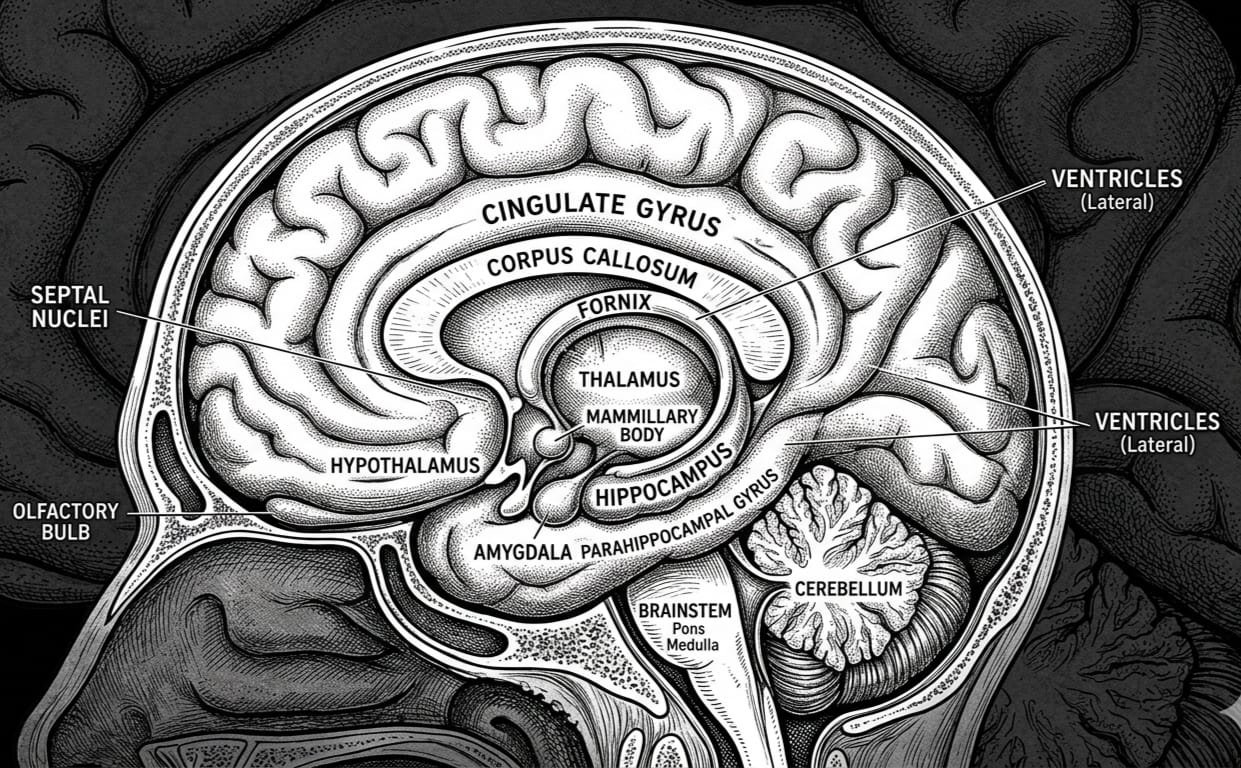
The Limbic System is a set of brain structures involved in emotional processing and motivation in humans. It is also known as Paleomammalian Cortex, located on both sides of the Thalamus, immediately beneath the Medial Temporal Lobe of the Cerebrum. It is not a single, unified structure but a network of interconnected regions that collectively influence emotional responses, motivation and the formation of memories. Human behaviour and long-term memory depend on these components and their functions.
Some important components of the Limbic system are Amygdala, Hippocampus, Cingulate gyrus, Para hippocampus gyrus, Hypothalamus, Fornix, Septal nuclei mammillary bodies and olfactory. Understanding the Limbic System is essential in neuroscience, psychology and clinical medicine for explaining the link between brain function, emotions and behaviour.
Functions of Limbic System:
1. Emotional Regulation — Fear, happiness and aggression are governed by a Limbic system
2. Memory Formation — The hippocampus and associated structures encode new memories and form short-term and long-term memories and their storage.
3. Behaviour and Motivation — It influences goal-directed behaviour and reward-based learning.
4. Olfactory Processing — Some Limbic structures are closely linked to the sense of smell, which can trigger emotional memories.
For an ordinary person, it is important to understand how we can keep our limbic system in a normal or better state. One of the important factors is meditation. Another is Yoga or regular exercises, which can keep the Limbic system in a healthy position and can reduce the aging process. We shall discuss it in our following Blogs about the components of the same.